
Humanitarian Disaster in Cabo Delgado
By Ezequiel Marcos Nhantumbo
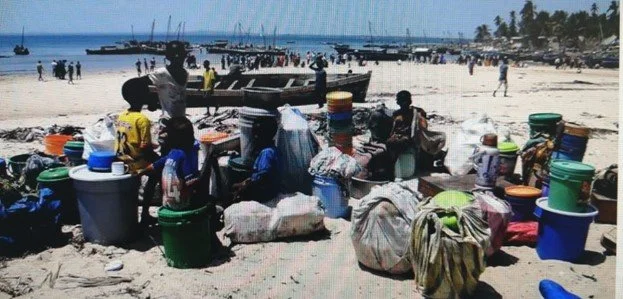
Day after day, 1,000 sailing boats are reported to be docking in the Paquitequete neighborhood in recent two months, in the City of Pemba, the capital of Cabo Delgado province, and other people desperately walking and/or driving to relatively safe places. The displaced people are coming mainly from villages of Olumboa, Guludo, Ntoni, Mucojo, Kirimizi and dozen additional villages, and Islands of the Quirimbas Archipelago and many other parts south of the Coastal city of Mocimboa da Praia, the districts of Muidumbe, Mueda, Quissanga, Macomia and Nangade.
More than 424,202 people have been displaced so far. Mozambican population is approximately of 29 million people, and the displaced population represents about 1.4% living in this condition, corresponding to 86,562 families. Only 3,981 people are already in 13 accommodation centers established by the Government and partners (CIP- Centro de Integridade Publica).
All this drama is due to the intense confrontations taking place in the mentioned districts. The battles between the Mozambique Defense Forces (FDS) and the insurgents. The conflict results in hunger, diseases and starvation, destruction of homes, schools, hospitals, politic and economic structures.
People of different age groups, many of which are children, young girls, women and the elderly people, fill to capacity the boats, carrying few essentials left over from ashes of burnt homes. It is indescribable! Social and economic infrastructures, including schools and hospitals, have been targeted by the insurgents, including barbarous beheading practices to children and adults, and others including children being trained and forced to join insurgents. There are reports of people vacating villages and main cities and walking miles and miles and many others sailing on boats, fleeing to much more secure places. Hundreds more are stranded in dense bushes with no alternative to walk or drive for long distances.
It is a severe emergency situation with ever-growing elements of insecurity and social instability, with increasing waves of displaced people arriving in cities which are already overpopulated. Many observers refer to this as one of the biggest humanitarian emergency ever in Mozambique history.


“People are still coming," writes Rev. Dercia Marrengula, the District Superintendent of Cabo Delgado district. "We hear that many people are hidden in the bushes and islands, and they take days on the sea once they are able to seek help on a given boat, sailing with nothing to eat and drink or cover their bodies, and with dangers of drowning, until they reach Pemba beach and other safer destinations. Our Church in Mocimboa da Praia, which had over 200 members, was looted and abandoned. Pregnant women are reported to have given birth in these vessels and still going through that in bushes. Theft, prostitution and other evil forms of violence are increase in the cities.”
She adds that the city of Mocimboa da Praia is desert and presently it serves as a theater for military operations. Battles with insurgents occur to control this strategic harbor position. There are limitations to tracing COVID-19 in conflict places. The entire population fled to many parts of Cabo Delgado, Nampula and Zambezia provinces. There are accommodation centers in Montepuez, Mueda, Pemba, Muadja, Metuge and some assistance is provided by the government, non-Government organizations and church denominations.
“Some of the Montepuez UMC members are currently displaced in parts of Cabo Delgado, Nampula and Zambezia. Montepuez UMC is inexistent. There are reports of hunger due to food shortage, malnutrition, lack of water, clothing and shelter. We may have to expect for the outbreak of water-borne diseases such as cholera and diarrhea. It is very complicated to control people’s movement and therefore diseases like Coronavirus, cholera and malaria may be of huge concern“

The capacity of institutions to deal with this social pressure will have to come in place, with the limitations in response to secure basic needs (water, food and temporary shelters, including provision of moral and psychological support, and health assistance for various ailments) for these groups of refugees.
Therefore if you have any encouragement from being united with Christ, if any comfort from his love, if any common sharing in the Spirit, if any tenderness and compassion, then make my joy complete by being like-minded, having the same love, being one in spirit and of one mind. Do nothing out of selfish ambition or vain conceit. Rather, in humility value others above yourselves, not looking to your own interests but each of you to the interests of the others. Philippians 2: 1-4
DS Dercia Marrengula reported that with few contributions of our church members at the district level, we were able to provide something at a resettlement center in Metuge for the refugees. Food and hygienic supplies such as rice, flour, sugar, beans, peanuts, oil, soap and horticultural seeds were delivered in this center, which comprises of approximately 8,000 displaced people.


“I recently visited, along with the Bishop Dinis Matsolo of the Wesleyan Methodist Church, the Administrative Post of Namialo where the largest number of displaced people from Cabo Delgado are concentrated. Accompanied by the Mozambique Christian Council Provincial chairman Armando Artur Colher, we joined the head of the Mulapani Admin Post Adelina Mucala. We were informed that since March 2020, this region has received 7,000 displaced people, some of which live in welcoming families, others in centers provided by the government (schools). The great challenge faced by the post is food assistance. The village of Corane placed them in schools, however at present these need to reopen. The Bishop suggested that we need to work with young people to avoid being lured by recruiting insurgents, and that the Council is on the ground to try and find better means for education and nutritional support the youth, including teaching them to do self-employing activities. The head of the post mentioned the need for psycho-social support because of brutal and horrible situation the population went through by the insurgents. We witnessed a situation where a single family with scarce means desperately has accommodated 65 refugees at Mulapani village.”

Love must be sincere. Hate what is evil; cling to what is good. Be devoted to one another in love. Honor one another above yourselves. Never be lacking in zeal, but keep your spiritual fervor, serving the Lord. Be joyful in hope, patient in affliction, faithful in prayer. Share with the Lord’s people who are in need. Practice hospitality. Bless those who persecute you; bless and do not curse. Rejoice with those who rejoice; mourn with those who mourn. Romans 12:9-15
The Mozambique Initiative feels that it is time to act and help save lives. As other organizations in the ground are involved in the provision of food, clothing and medication, and realizing that these actions are a long-run process, the Initiative intervention could be centered in the provision of safe water, drilling wells in accommodation resettlement, and moving from charity to development and transformation levels, through building vocational school (s) - 3 classrooms, a chapel, administrative block, and toilets. It has been said that most of those involved in this conflict are unemployed and unoccupied young people, who at the first sight are lured by insurgents for acts of sabotage and terrorism.
Vocational schools will help young people and adults to develop skills to help them make decisions and give direction to their academic and professional careers, and above all aiding to doing things, including practice of sport and cultural activities. Vocations will include carpentry, welding, sewing and design, cooking, small food transformation plants, tourism, etc. People will then be equipped with tool kits to begin self-employed activities to help sustain own families and develop communities.
Pastoral care and counseling to refugee communities is fundamental, and it is to be provided by a trained Chaplain, respecting religious boundaries and allowing refugees, who are mostly Islamists, for the inclusiveness and fully participation in all educational activities. Point to note that Muslims have for quite long period been working alongside in a cooperative manner with other denominations, intervening in problem solving issues countrywide.
“Oil deposits, liquefied natural gas fields and gemstones, projected in 2010 to be worth billions, have culminated in a shift in the political and social climate in neglected Cabo Delgado. Extremist insurgents, which some have claimed are linked to terrorist movements, are operating with a sophistication and weaponry that have not previously been seen in the country. Their exact demands and political and economic ideology are currently unknown.” (Nation Nyoka, Oct 21 2020).
Your prayers and support are needed to help alleviate suffering of our sisters and brothers in Cabo Delgado.